The Centrifugal Compressor: The Rotating Heart of the Plant That Cannot Fail

In Oil & Gas facilities, few pieces of equipment have as much operational impact as the centrifugal compressor. Found in process units, gas transportation systems, LNG plants, or offshore installations, this type of machinery is essential to ensure continuous gas flow and the stability of critical processes.

An unplanned shutdown of a centrifugal compressor can result in losses of millions per day, contractual penalties, and, in the worst cases, serious safety or environmental incidents. Therefore, its maintenance cannot rely solely on periodic inspections or lab analyses—it must be supported by an advanced and continuous condition monitoring strategy.
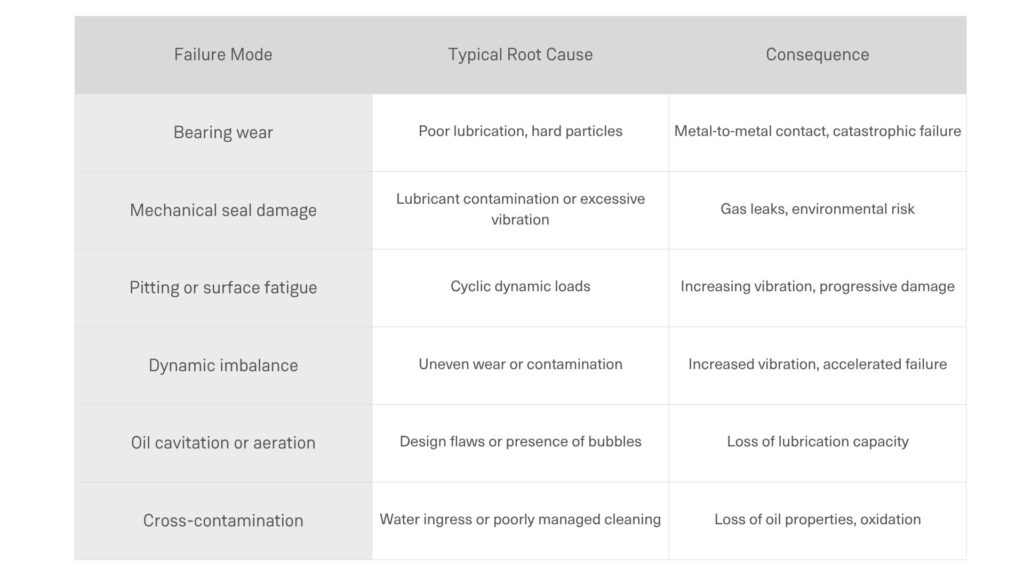
Most Common Failure Modes in Centrifugal Compressors

Despite their apparent robustness, centrifugal compressors are vulnerable to various internal failures that, if not detected in time, can lead to critical breakdowns:

The Consequences of an Unplanned Shutdown

When a centrifugal compressor fails unexpectedly, the consequences multiply:

  • Direct and collateral production losses in upstream or downstream processes
  • Chain damage to connected equipment (motors, gearboxes, piping)
  • Long repair times (due to criticality and need for specific spare parts)
  • Reputational and contractual impact, especially in offshore or export operations
  • Environmental risks in case of gas or oil leaks in classified zones

That’s why it’s not just about “maintaining it well,” but about accurately anticipating when internal degradation is occurring—even before external symptoms appear.

The Role of Lubricant Condition Monitoring

The lubricant in a centrifugal compressor is not just a medium to reduce friction—it’s a valuable source of data on the internal health of the equipment. The particles circulating in the oil tell a precise story about the wear occurring in key components.

For condition monitoring to be truly useful, the system must:

  • Identify not just the quantity but the shape of particles:
    This helps distinguish between fatigue, adhesive, or abrasive wear, providing direct clues to the failure mode in progress.
  • Differentiate between air bubbles and water droplets:
    The presence of microbubbles, aeration, or emulsions may indicate design flaws, filtration issues, or extreme operating conditions.
  • Detect trends in real time:
    Instead of waiting for external analysis or a scheduled shutdown, continuous detection allows action before damage becomes irreversible.
  • Operate in ATEX environments:
    Since many compressors are located in classified zones, the sensor must be safe and certified for Zone 1 operation.

Atten[2] can help you to monitor your critical applications in explosive environments with our OilWear EX

The future of predictive maintenance lies in understanding what is happening inside the equipment, without needing to dismantle it. And oil is the most direct way to achieve that.

Centrifugal compressors are strategic assets whose failure has a disproportionate impact on operations. Today’s technologies allow us to go beyond traditional vibration or pressure monitoring and obtain direct intelligence from the lubricant itself—provided the sensors can distinguish real particles, identify their origin, and filter out false alarms.

[ Knowledge ] centre

Latest related posts

[ SEE MORE ]

The Silent Lung in Explosive Environments: Compressors and Lubricated Equipment in ATEX Zone 2 / Class I, Division 2 Areas

In facilities where hydrocarbons or flammable gases are handled, such as refineries, chemical plants, or…
[ SEE MORE ]

What the Most Experienced Maintenance Leaders Do Differently in Classified Areas

In a typical industrial plant, a mechanical failure may just be a production issue. In…
[ SEE MORE ]

What should you demand from a particle analysis system when working with compressors, pumps, or gearboxes in explosive environments?

In industrial environments classified as ATEX Zone 2 or Class I, Division 2 (Groups C-D,…
[ SEE MORE ]

The Critical Role of Particle Counting in the Oil & Gas Industry: Why You Can’t Afford to Ignore It

In the oil & gas sector, equipment reliability is paramount, especially given the high cost…